
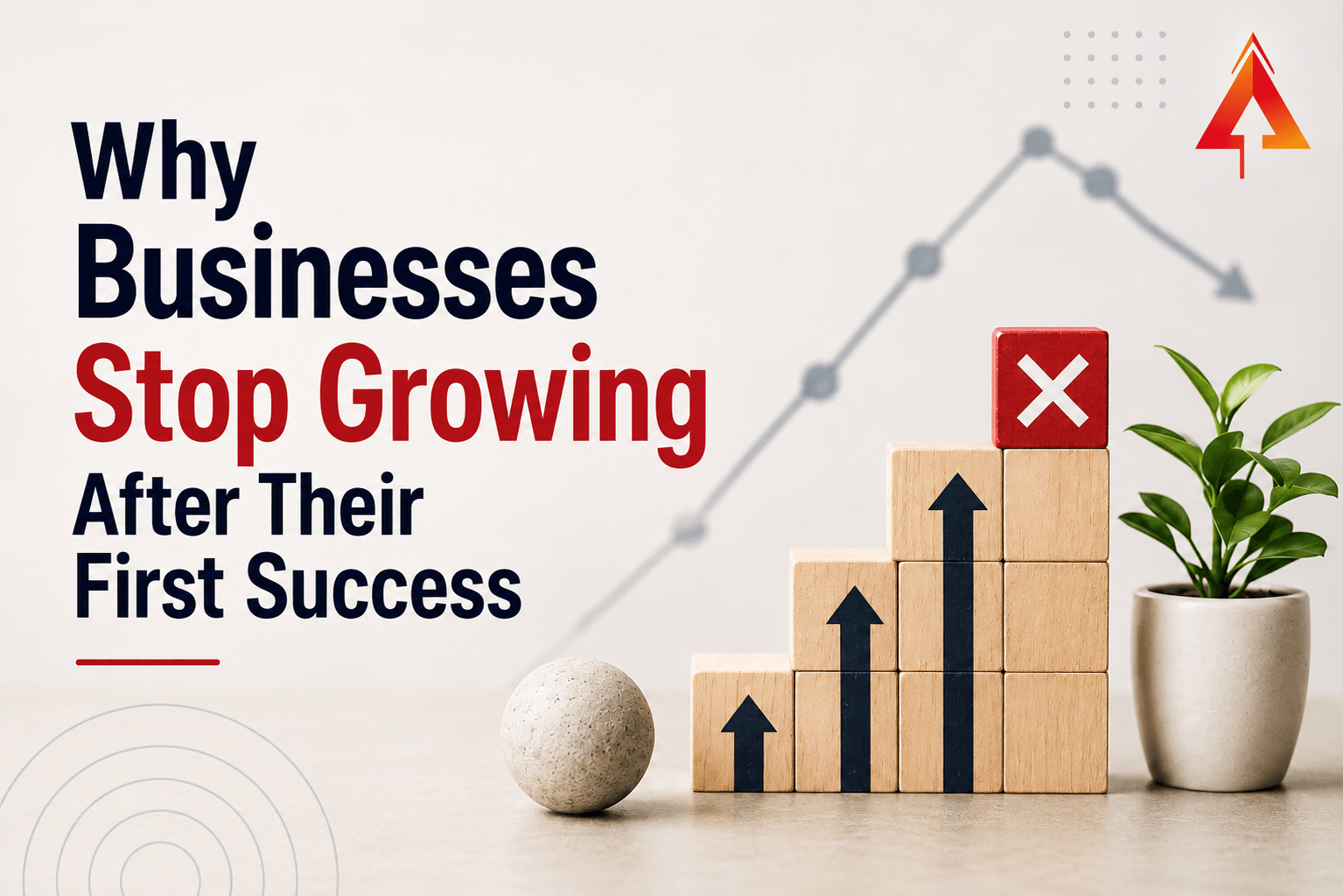
Nobody warns founders about the plateau that shows up right after they finally succeed.
There’s plenty written about the struggle to get the first customer, the first hire, the first real month of revenue. Almost nothing prepares founders for what happens next: the business hits a comfortable, working size — steady clients, decent revenue, a team that mostly runs itself — and then quietly stops growing, sometimes for years, while the founder keeps insisting it’s just a temporary slow patch.
It’s rarely temporary, and it’s rarely bad luck. A first success creates a specific set of conditions that, left unexamined, become the exact thing that stalls the next stage of growth. Here’s what actually causes the plateau, and what breaks it.
The Founder Becomes the Bottleneck
Early success is often built entirely through the founder — their instincts, their relationships, their willingness to personally handle everything. That’s not a flaw at the start; it’s usually the only way a business survives its first year.
The problem is that this pattern rarely gets deliberately retired once it’s no longer necessary. Every decision, every approval, every important client conversation keeps routing through one person, long after the business has grown past what one person can actually carry. Growth doesn’t stall because the market dried up. It stalls because the founder is now the ceiling the entire business quietly bumps against, every single day.
What breaks it: Identify the decisions and tasks that genuinely require you, and deliberately hand off everything else — even the things you’re better at than the person you’re handing them to. Capacity, not perfection, is the constraint that matters now.
A simple test: for one week, note every time someone waits on you for something they could plausibly have decided themselves. If that list is long, the bottleneck isn’t the market, the team, or the economy. It’s a calendar with one person’s name on every important line.
They Stop Listening to Customers the Way They Did at the Start
In the beginning, most founders are obsessive about customer contact, because they have no other way to learn what’s working. Once revenue stabilizes, that obsession usually fades — replaced by hiring, operations, and the daily administration of running a bigger business. The direct line to customers goes quiet, right around the time the business most needs fresh insight to find its next stage of growth.
This is how businesses end up perfecting something the market has already moved past. Nobody told them, because nobody at the top was still listening closely enough to hear it.
What breaks it: Rebuild a standing habit of direct, unfiltered customer contact — not a quarterly survey summarized by someone else, but the founder personally hearing the actual words customers use, on a regular schedule, for as long as the business exists.
They Ride One Channel Until It Breaks
Most first successes are built on one thing working unusually well: one marketing channel, one referral source, one product line, one big early client relationship. That concentration is often exactly what made the early traction possible — focus beats a scattered effort every time.
The trouble starts when that one channel is treated as a permanent feature of the business rather than a single, finite source that will eventually saturate, get more expensive, or simply stop performing the way it once did. When it inevitably slows, growth doesn’t just soften. It stops, because there was never a second engine built alongside the first.
What breaks it: While your primary channel is still working well, deliberately invest time and money testing a second one — not because the first is failing yet, but because it eventually will, and the time to build the next engine is before you desperately need it.
They Protect What They Built Instead of Building What’s Next
Before success, a founder has nothing to lose, which makes bold decisions easy. After success, there’s suddenly something real to protect — steady revenue, a working team, a reputation — and that changes the psychology of every decision that follows. Risk that once felt exciting now feels threatening.
This shift is rarely a conscious choice. It shows up as a founder who used to move fast on new ideas suddenly finding reasons to wait, to research further, to protect the existing thing rather than risk it for the next one. The business that once took the bold swing that created its first success stops taking any swing at all.
What breaks it: Deliberately protect a small, bounded portion of time, money, or team capacity for genuinely risky bets — treated as a fixed cost of continuing to grow, not an occasional indulgence you get to when things are quiet.
They Never Started a Second S-Curve
Every product, channel, and market follows a predictable shape: slow start, rapid growth, then an eventual flattening as it matures and saturates. A business’s first success rides the steep, exciting middle of that curve. The mistake is assuming the curve continues indefinitely, rather than recognizing it will eventually flatten no matter how well it’s executed.
Businesses that keep growing don’t avoid this flattening — nothing does. They start building the next curve, the next product or market or capability, while the first one is still climbing, so the flattening of the old curve overlaps with the rise of the new one instead of leaving a gap.
Picture a business built entirely on one flagship product, still growing steadily but at a visibly slowing rate each quarter. Founders who wait until that growth actually stops before starting something new usually face a painful gap — months or years of flat or declining revenue while the next thing gets built from scratch, under pressure, with far less room to experiment. Founders who start testing the next product or market while the first is merely slowing, not yet flat, get to build the next curve calmly, funded by a business that’s still healthy.
What breaks it: Ask honestly where your core product or channel actually sits on its curve right now, and if it’s anywhere past the steep middle, start deliberately building what comes after it — before the flattening forces the question on you.
They Confuse “What Got Us Here” With “What Got Us Here Forever”
The habits, decisions, and instincts that created the first success feel proven, which makes them very hard to question. That’s precisely the trap: the specific behaviors that worked to get a business from zero to its first real win are frequently not the same behaviors that will take it to the next stage — and founders who keep repeating them anyway, simply because they worked once, are often the last people in the business to notice they’ve stopped working.
What breaks it: Periodically and deliberately ask which of your current habits and decisions were built for a business that no longer exists — a smaller team, a single product, a founder who could still personally touch every customer — and be willing to retire them, even though they’re the exact habits that got you this far.
The Skimmable Summary
- The founder often becomes the bottleneck once the business outgrows what one person can carry — hand off capacity, not just tasks you dislike.
- Direct customer contact fades after early success, right when the business most needs fresh insight — rebuild the habit deliberately.
- A single successful channel eventually saturates. Build the second one while the first is still working, not after it stops.
- Success changes your relationship with risk. Protect a small, fixed amount of capacity for genuinely bold bets, on purpose.
- Every curve flattens eventually. Start the next one before the current one does, so growth overlaps instead of leaving a gap.
- The habits that created your first success are not automatically the habits that create your next one. Question them on a schedule, not only once they’ve already failed you.
Your Next Step
Pick the single area above that made you the most uncomfortable while reading it — that’s usually the one quietly costing you the most growth right now.
Write down one specific, honest example of it happening in your business this month. Then write one concrete action you’ll take in the next two weeks to interrupt the pattern — a task you’ll hand off, a customer call you’ll personally make, a small test on a second channel, a genuinely risky idea you’ll finally greenlight.
Plateaus don’t announce themselves. They just quietly become the new normal, one comfortable month at a time, until a founder looks up and realizes the business hasn’t meaningfully grown in over a year. Look at your numbers honestly today, while it’s still a choice to change — not yet a crisis that forces it.

EntrepreneursLeague is an initiative to support startups and leading entrepreneurs with more visibility, resources, and community for growth and networking.