

Skip the “women lead with more empathy” cliché. It’s not wrong, exactly — it’s just incomplete, and it quietly lets everyone off the hook.
The more useful truth is this: high-performing women leaders are often operating in the same organizations as everyone else, but with measurably less sponsorship, more scrutiny of the same behaviors, and a well-documented bias against being seen as both competent and likeable at once. What’s remarkable isn’t that some women lead brilliantly despite that. It’s the specific, learnable things they do differently to make it work anyway — practices any leader, of any gender, would benefit from adopting deliberately.
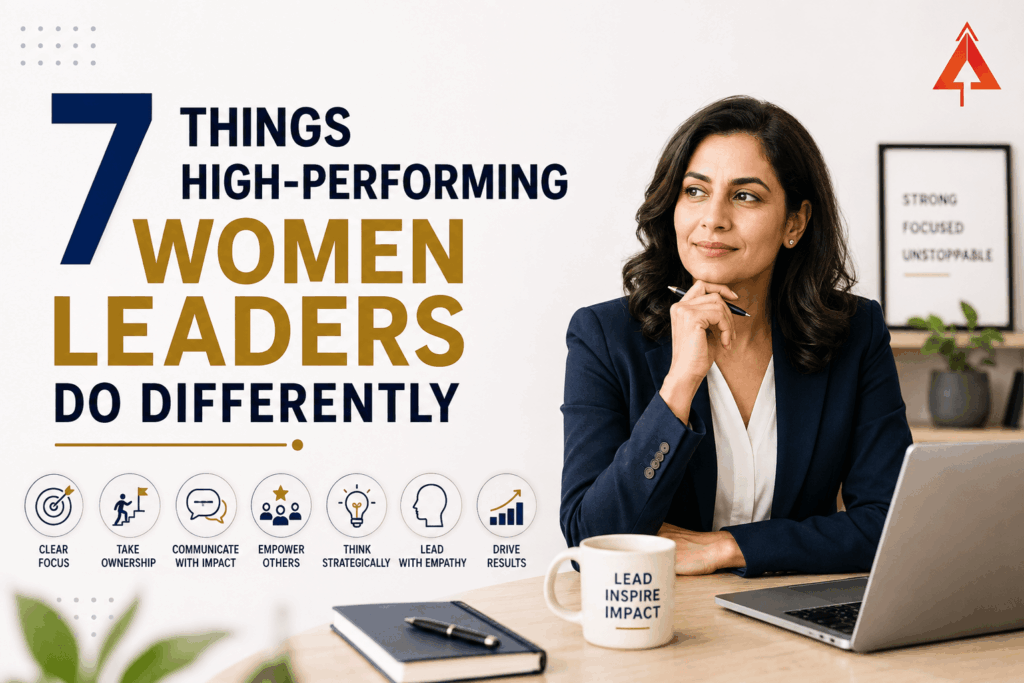
None of what follows is about innate traits or “how women naturally are.” It’s about specific, observable behaviors, backed by real research, that distinguish the leaders who break through from those who plateau despite equal talent. Here are seven of them, grounded in real research rather than inspirational posters.
1. They Protect Their Health and Energy as a Leadership Asset
Burnout among senior women leaders isn’t a minor complaint — it’s a documented, worsening trend. McKinsey and LeanIn’s 2025 Women in the Workplace research found that 60% of senior-level women report frequently feeling burned out, compared to 50% of senior-level men, the highest level recorded in five years of tracking. The strain is even sharper for women newer to leadership, and sharper still for senior Black women, nearly 8 in 10 of whom report frequent burnout.
High-performing women leaders don’t treat this as an unfortunate cost of the role to quietly absorb. They treat their own health, sleep, and recovery as a direct input into their ability to lead well — protected on purpose, not sacrificed first when things get busy, because a depleted leader makes worse decisions regardless of how talented they are underneath the exhaustion.
The practice: Name the one part of your health you’re currently sacrificing first under pressure — sleep, movement, real time off — and protect it deliberately this month, treating it as non-negotiable rather than optional.
2. They Lead in a Style That’s Rated Effective, Not Just “Nice”
There’s a persistent myth that collaborative, transformational leadership is a softer alternative to “real” results-driven leadership. The research says otherwise. A landmark meta-analysis of 45 studies by Alice Eagly and colleagues found that women leaders score modestly higher, on average, than men on transformational leadership — the style built around inspiring people, developing their skills, and leading by example — and that this exact style consistently correlates with stronger leadership effectiveness ratings.
The difference in the research is described honestly as small, not massive — this isn’t “women are naturally better leaders.” It’s that a leadership style many women have been socialized or expected to use happens to be the one the evidence keeps validating as genuinely effective, regardless of who’s using it.
The practice: Don’t downplay a collaborative, developmental leadership style as merely “nice.” Treat it as a strategic strength — and describe it in exactly those terms when you talk about your own leadership.
3. They Navigate the Double Bind Instead of Getting Stuck In It
Older but still-relevant research on leadership evaluation found something uncomfortable: people rate women who lead with a direct, autocratic style notably more harshly than men using the identical style. This isn’t a performance gap. It’s a perception bias — the same behavior read as “decisive” in one leader and “difficult” in another, based purely on who’s doing it.
High-performing women leaders don’t simply ignore this dynamic and hope it resolves itself, nor do they fully soften their leadership to avoid it. They get strategic — pairing clear, direct decisions with visible warmth and context, not because directness needs an apology, but because they’ve learned exactly how their message will land and choose their delivery deliberately, without diluting the substance of the decision itself.
The practice: Stay direct about the decision. Get deliberate about the delivery — explaining the “why” alongside the “what” tends to land a hard call without softening its content.
4. They Treat Peer Networks as Real Infrastructure
Formal sponsorship from senior leaders matters, but it isn’t the only support that moves careers. Peer-level support — people at a similar stage, facing similar challenges, genuinely invested in each other’s success — has been shown to be nearly as effective as traditional top-down mentorship, which is exactly why structured peer groups like LeanIn Circles have spread as a deliberate strategy rather than an informal nicety.
High performers build this intentionally: a small, trusted group they can be honest with about real challenges, not just a broad professional network collected for its own sake.
The practice: Build or join a small, consistent peer group — four to six people, meeting regularly, with enough trust for real talk. It compounds in ways a large LinkedIn network never quite manages to.
5. They Protect Their Ambition From an Environment That Quietly Discourages It
Recent workplace research surfaced something worth sitting with: when women and men receive equal career support, their ambition to advance is identical. The well-known “ambition gap” isn’t a motivation problem at all — it’s a support problem, and it disappears entirely once real support is present.
High-performing women leaders don’t wait for their environment to correct this on its own. They treat their own ambition as something worth actively protecting — seeking out the specific support, opportunities, and advocacy that the data shows makes the difference, rather than absorbing an under-supportive environment as evidence their ambition was somehow misplaced.
The practice: If your ambition feels like it’s fading, question the environment before you question the ambition. The data suggests the environment is very often the actual variable.
6. They Ask Directly, Instead of Waiting to Be Noticed
Being sponsored measurably changes behavior: people with real advocates are more likely to ask for the stretch assignment, the raise, the next-level opportunity — because someone in their corner has made asking feel viable rather than risky. Without that backing, the instinct to wait quietly for recognition is far stronger, and far less effective.
High performers learn to ask directly regardless of whether a sponsor is already in place — naming the specific opportunity, role, or number they want, out loud, to the person who can actually grant it.
The practice: Replace “I hope this gets noticed” with a direct, specific ask, made to a specific person, on a specific timeline.
7. They Negotiate the Load at Home, Not Just at Work
The imbalance many women navigate doesn’t stop at the office door. Pew Research Center found that even when a wife is the primary breadwinner, she still spends roughly one and a half more hours a week on caregiving and two more hours on housework than her husband — who, in that same arrangement, ends up with about nine more hours of leisure time. Financial success at work has not, on its own, closed the gap in who carries the load at home.
High-performing women leaders tend not to treat this as a private, separate problem from their career. They negotiate it directly and specifically — dividing chores and caregiving by explicit agreement rather than default assumption — recognizing that energy quietly drained at home is energy unavailable for leading well the next day.
The practice: Pick one specific household or caregiving responsibility that’s landed on you by default rather than by choice, and have an explicit, direct conversation this week about redistributing it.
The Skimmable Summary
- Burnout among senior women leaders is at a five-year high — protect sleep, recovery, and health on purpose, not as an afterthought.
- Transformational, developmental leadership isn’t “soft” — it’s consistently linked to stronger effectiveness ratings in the research.
- The double bind around directness is a real, documented bias — pair clear decisions with visible context, without diluting the decision itself.
- Peer networks are genuine career infrastructure, not just informal support — build a small, consistent group on purpose.
- The “ambition gap” is a support gap, not a motivation gap — protect your ambition by pursuing support, not by lowering your goals.
- Asking directly outperforms waiting to be noticed — name the specific ask, to the specific person, on a specific timeline.
- The load at home doesn’t rebalance on its own, even with career success — negotiate it explicitly, not by default.
Your Next Step
Pick the one practice above that you’re currently doing the least of — not the one that sounds easiest, the one you’re actually avoiding.
If it’s protecting your health, name the one thing you’ll stop sacrificing first this month. If it’s asking directly, write the specific request you’ve been circling around, and say it out loud to the right person before the week ends. If it’s the load at home, have the direct conversation this week, not “eventually.”
High performance isn’t just talent showing up consistently. It’s a handful of deliberate practices, chosen on purpose, in an environment that doesn’t always make them easy. Choose one today.

EntrepreneursLeague is an initiative to support startups and leading entrepreneurs with more visibility, resources, and community for growth and networking.