
If the only marketing numbers you track are ROAS, cost-per-click, and conversion rate, congratulations — you’re optimizing a business that gets more expensive to run every single year.
That sentence probably stings a little, because performance marketing feels like the responsible choice. It’s measurable. It’s defensible in a board meeting. You can point to a dashboard and say, “this ad spent ₹10,000 and returned ₹40,000.” Try saying that about a brand campaign, and you’ll get blank stares.
But measurability isn’t the same as effectiveness. And the uncomfortable truth is that most founders have quietly built their entire growth engine on the one lever that gets more expensive, more crowded, and less effective every year it runs alone.
Let’s untangle brand building and performance marketing properly — what each one actually is, why founders default to the wrong one, and how to know which one your business is neglecting right now.
The Core Difference, Simply Put
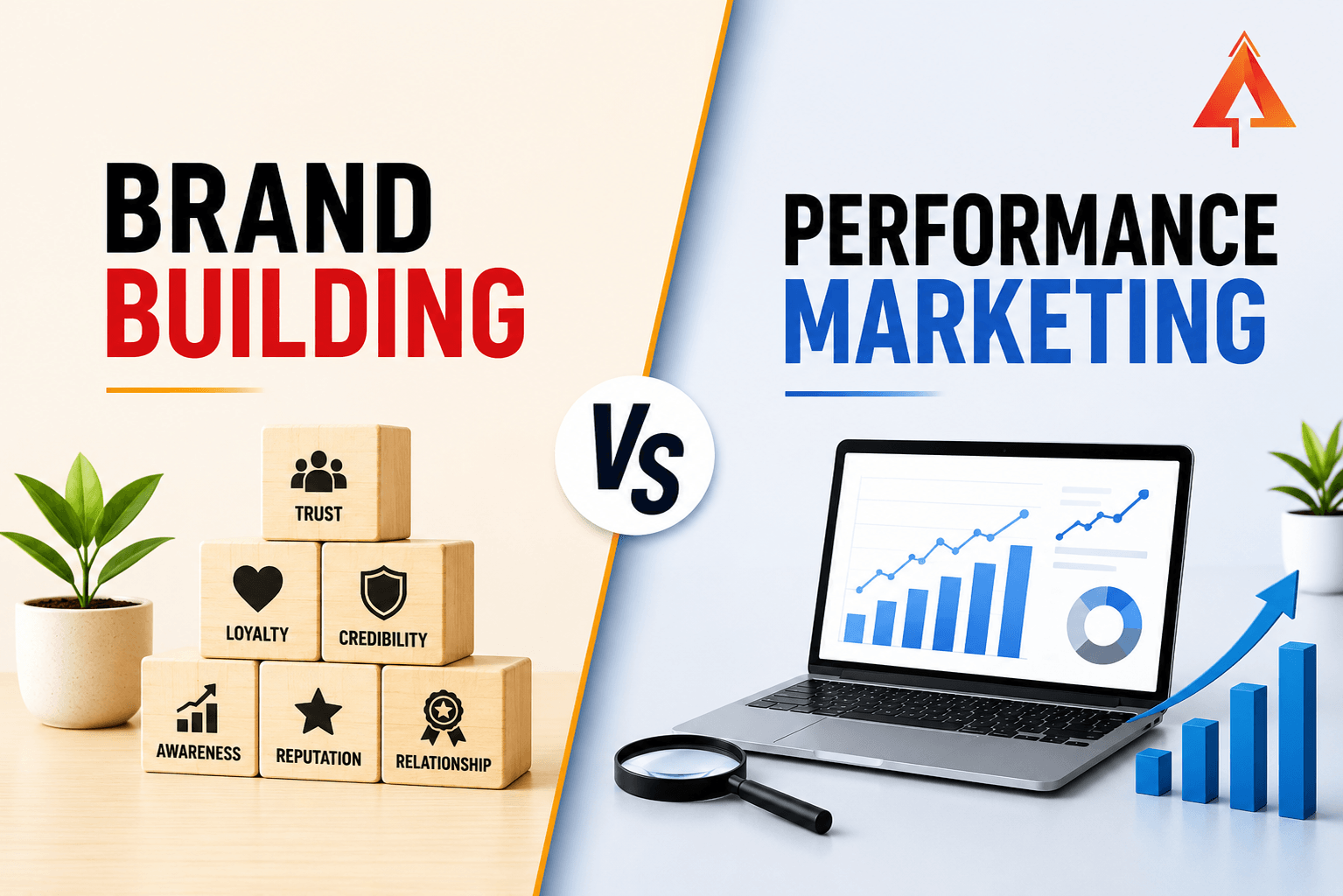
Performance marketing is anything designed to make someone act now — a search ad, a retargeting campaign, a discount code, a “buy today” push. You can measure it almost instantly, and that immediacy is exactly its appeal.
Brand building is everything designed to make someone think of you later, without being asked to. It’s the accumulated impression left by your positioning, your consistency, your content, your customer experience, your reputation — the reason someone types your name into a search bar instead of “best [category] near me.”
Neither one is optional. Performance marketing converts demand that already exists. Brand building creates the demand in the first place. A business running only performance marketing is fishing in a pond that never gets restocked.
Think of it this way: a search ad for “accounting software” catches someone who has already decided they need accounting software today. A year of consistent, useful content about financial clarity for small business owners is what makes that same person think of your name specifically, before they’ve even typed the search — or better still, search for you by name instead of the generic category term. One captures a decision already made. The other shapes which brand comes to mind when the decision gets made in the first place.
Why Founders Default to Performance Marketing
It isn’t laziness. It’s structural pressure. Performance marketing gives you a number within 24 hours. Brand building might not show a measurable effect for months. When you’re a founder answering to your own cash flow, or to investors asking about this month’s numbers, the instant feedback loop of performance marketing feels far safer to defend — even when it’s quietly the more expensive long-term choice.
There’s also a data problem baked into the incentive: most attribution tools are built to credit the last click, which almost always looks like a performance channel, even when a brand impression from months earlier was what actually made the sale happen. The dashboard tells a flattering story about the wrong question.
This isn’t a small, theoretical bias. Industry-wide ad spend data has shown marketing budgets tilting further toward short-term activation over the last several years — with brand-building share shrinking even as research kept showing the opposite allocation performed better over time. Founders aren’t imagining the pull toward performance. It’s real, it’s structural, and it’s led plenty of otherwise smart marketers astray.
The Real Cost of Performance-Only Marketing
Here’s what performance-only marketing does over time, quietly: your cost of acquisition climbs, quarter after quarter. Not because your ads got worse — because you’re competing for the same shrinking pool of people who are ready to buy right now, and every competitor doing the same thing bids that pool up.
Meanwhile, nothing is being built that compounds. Turn off the ad spend, and the sales stop the same week. There’s no reservoir of goodwill, recognition, or preference sitting in the customer’s mind, quietly working in your favour even when you’re not actively advertising. You’ve rented attention. You haven’t earned any.
This shows up as a very specific, very avoidable failure pattern: a founder pauses ad spend for a month — cash flow tightens, priorities shift, whatever the reason — and revenue doesn’t just dip, it collapses to near zero. That’s the tell. A business with real brand equity sees a dip when it stops advertising. A business with none sees a cliff, because the ad spend wasn’t supplementing demand — it was the entire source of it.
The well-known research on this — Les Binet and Peter Field’s analysis of nearly a thousand advertising effectiveness case studies — found that campaigns weighted too heavily toward short-term activation produced a sharp initial spike, followed by long-term decline in market share and pricing power. Their famous “60:40” finding suggested that, on average, effective brands allocated roughly 60% of spend to long-term brand building and 40% to short-term activation. It’s a guideline drawn from averages, not a law — the right split shifts with your category, your size, and how established you already are, and some respected researchers argue the exact ratio matters less than simply not neglecting brand entirely. But the core pattern — activation alone erodes, brand building compounds — has held up remarkably well.
What Brand Building Actually Buys You
Brand building isn’t a TV commercial budget only big companies can afford. For a founder, it’s every deliberate thing that makes a stranger recognize, trust, or prefer you before they’ve clicked an ad — a consistent visual identity, a clear point of view your content keeps repeating, a customer experience distinctive enough that people describe it to friends, a reputation built through reviews, testimonials, and community presence.
What it buys you is compounding. Every unit of brand trust you build stays with the customer whether or not you’re actively running ads that week. It shows up later as a lower cost of acquisition — because people search for you by name instead of needing to be found through an ad. It shows up as pricing power — because a trusted, familiar brand can charge more than an anonymous one for the same product. And it shows up as resilience — a recognizable brand survives a bad quarter of ad performance far better than a business with no identity beyond its last campaign.
The Right Mix Changes With Your Stage
None of this means an early-stage, cash-constrained business should ignore performance marketing in favour of brand purity. In the first year, you often need performance marketing simply to survive — to get enough revenue in the door to justify existing at all. That’s a legitimate, necessary use of the lever.
The mistake isn’t using performance marketing early. It’s still relying on it exclusively three years later, once you can afford to build something that compounds. As your business stabilizes, the healthiest shift is gradual: start layering in brand-building actions — consistent content around a clear point of view, a recognizable visual identity, real customer stories — even while performance marketing keeps the immediate pipeline full. Over time, that ratio should keep tilting toward brand, not because performance stops working, but because your growing brand strength should be doing more and more of the work performance marketing used to have to do alone.
The Skimmable Summary
- Performance marketing converts existing demand. Brand building creates new demand. You need both, but they are not interchangeable.
- Measurability isn’t effectiveness. The channel that’s easiest to track isn’t automatically the one doing the most work.
- Performance-only marketing gets more expensive over time, because you’re bidding for the same shrinking pool of ready-to-buy customers.
- Brand building compounds. It keeps working even in weeks you’re not actively spending on ads.
- Research consistently shows over-investment in short-term activation erodes long-term market share and pricing power, even though it looks fine on a weekly dashboard.
- Brand building is affordable at any size — consistent identity, a clear point of view, and a distinctive customer experience all count, with or without a big budget.
- The right mix shifts with your stage. Lean on performance marketing to survive early; deliberately shift more weight toward brand as you stabilize.
Your Next Step
Pull up your last three months of marketing spend and time — not just the media budget, but your own hours too. Split it honestly into two piles: things designed to make someone act this week, and things designed to make someone remember you next year.
If the second pile is close to empty, that’s your answer. Pick one brand-building action you can start this month — a consistent content theme, a customer story worth telling publicly, a visual identity tightened across every touchpoint — and commit real time to it, even though it won’t show up on a dashboard by Friday.
Your performance ads are buying you this quarter. Your brand is the only thing that makes next year’s customers cheaper to reach than this year’s. Start building it on purpose, not as an afterthought once the ad costs finally catch up with you.

EntrepreneursLeague is an initiative to support startups and leading entrepreneurs with more visibility, resources, and community for growth and networking.