

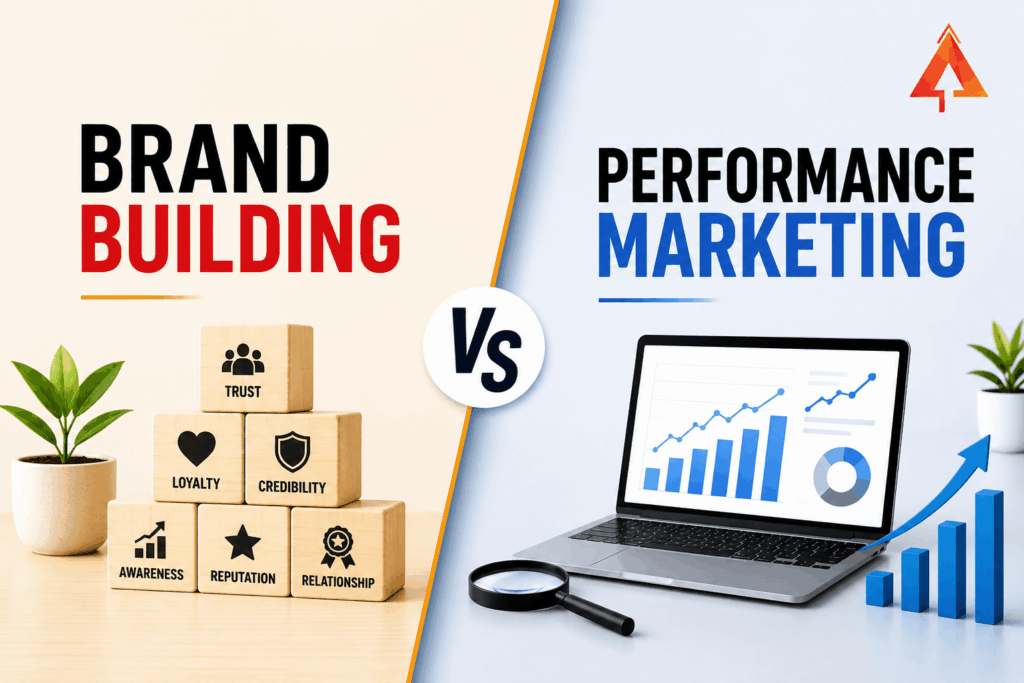
The dilemma is whether to measure the business by its performance metrics or by its brand value. On one hand, performance marketing is easier to measure. Conversion rates or cost-per-click tell you exactly what you spent and what you got in return. But how can one assess if the brand has built a name for itself?
Unfortunately, many founders build their business on performance marketing. But this system gets more costly and competitive as each year goes by. So, what is the solution, and how can a brand do both – build its value and perform well?
What Is Performance Marketing and Brand Building?
Performance marketing is an instant or immediate call to action. The customer is encouraged to act ‘now’. It could be a ‘Buy Now’ button, a discount coupon or a targeted ad.
Brand building is the process that makes customers think of the brand ‘later.’ It is the slow and steady efforts from website content, logo or engaging with audiences regularly that bear the rewards in the long-run. A customer is so accustomed to your brand that he/she searches for it right away instead of searching for the product or service they require.
Both performance marketing and brand building are important for the growth of the business. The former caters to an existing demand. The latter plays a role in creating the demand. But if a business is only concentrating on performance marketing, it is depleting without creating new resources. For instance, a person wants to buy accounting software and sees an ad about it. He/she can click on it and make the purchase. Another scenario is that because you have been posting about finance and have built a brand name, the person thinks of you. The customer types your brand name to purchase the software instead of clicking on an ad that already shows up. In the first case, the purchase is steered by the decision to buy the product. In the second, the brand value enables the customer to remember the brand when an associated purchase is required.
Why Performance Marketing Trumps
Most founders focus more on performance marketing. It is not because it’s easier to do. But because it is also easier to show results for. It gives you the daily numbers, which brand building cannot. For a founder who is answerable to investors and his team, the results from performance marketing are tangible and real numbers to work upon or defend. However, performance marketing is also more costly in the long run.
There is another reason why founders are inclined towards performance marketing. Most of the available tools monitor the last click or action. What is measured is that the purchase was made. What is not measured is that it was perhaps a brand-building initiative or impression in the mind of the customer that led to the purchase.
It is also true that industries across the board spend more on short-term marketing. Budgets for brand building are usually less, despite research indicating that building the brand works better in the long-term.
Quick Read – Daily Habits of High-Performing Entrepreneurs
Price of Performance Marketing
Performance marketing may give quick results. But over time, the expenses rise. This is not because the ad or quality of marketing falls. It is because you are competing with other brands over the diminishing group of people who are looking to buy instantly or now.
At the same time, there is no work being done to compound performance marketing techniques. If the ad is taken off, there are no sales. There is no memory of the brand created in the minds of the people. The sales worked till the ads worked.
But a business that also builds its brand experiences a different pattern. When an ad stops, the sales do not crash or collapse. There is a dip, but the sales do not completely come to a standstill. When businesses solely rely on performance marketing, it becomes the only source of meeting demand.
There are also various studies that explain this further. Les Binet and Peter Field analysed several advertising case studies. They found that brands that invested in short-term campaigns saw an initial spike in sales. But it was followed by a long-term fall in pricing power and market share. They suggested the 60:40 rule. Brands that allocated 60% of their marketing expenses to brand building and 40% to short-term performance gains were more effective than the rest. The exact split ratio can also vary according to the brand’s size, experience and other factors. However, it is clear that companies need to split their marketing costs between performance marketing and brand building, rather than spending all on only one.
The Role of Brand Building
Brand building is done in various ways. It is not only about big commercials that small businesses may not be able to afford. Brand building is about forming trust with customers. It could entail consistent messaging, constant engagement or distinct visual appeal. It is also most definitely providing high-quality products and services that customers rave about to family and friends. Brand building is not an overnight process. It takes time and effort for the company to build a relationship through consistency and honesty.
Brand building positively impacts the business in the long run. When customers search for your brand by name and do not find you through your ad, the business lowers its acquisition cost. Similarly, you have better control over pricing when customers are willing to pay a higher price for your product even when an unknown brand charges less. A business that survives a bad financial quarter of performance marketing is the one that has given due credit to building its brand.
When To Do Which?
It is established that both brand building and performance marketing are essential. But both can be pursued with different intensity at different stages of the business. For instance, for a novice company that is low on finances, performance marketing can be a real boost. It helps the company take its baby steps and start getting revenue to grow. Performance marketing at this stage is a necessary and smart thing to do.
But even when the business is a few years old, to continue to exclusively rely on performance marketing can be dangerous. Once the company can afford it, it is a wise decision to start building the brand. Slow and consistent efforts, such as visual distinctiveness and promoting customer reviews and stories, make the brand recognisable. Performance marketing can be continued, but with time, the marketing share allotted to brand building can be increased. In the end, the business must aim for brand building to do the work that was once done by performance marketing.
Suggested Read – AI Tools Every Solo Entrepreneur Should Start Using Today
A Quick Summary
- Performance marketing is the answer to existing and immediate demand. Brand building helps create new demand.
- Though performance marketing is easier to track, it may not necessarily be more effective than brand building in the long run.
- With time, performance marketing gets expensive. You are competing for a sale in a pool of diminishing customers who want to buy immediately.
- Brand building tides the business over even when the business stops spending on ads.
- Research shows that overinvesting in the short term can lower pricing power and market share in the long run.
- Brand building can be done by both big and small businesses. It requires consistent and clear messaging along with high-quality products and services.
- The share of performance marketing and brand building can change according to the stage in which the business is.
Where performance marketing boosts sales in the initial stages of the business, brand building sustains its market share and value for years to come. Both performance marketing and brand building are required for businesses to find the right balance. One may overpower the other at different stages, but overall, both contribute in varying degrees to the growth of the brand.

EntrepreneursLeague is an initiative to support startups and leading entrepreneurs with more visibility, resources, and community for growth and networking.