
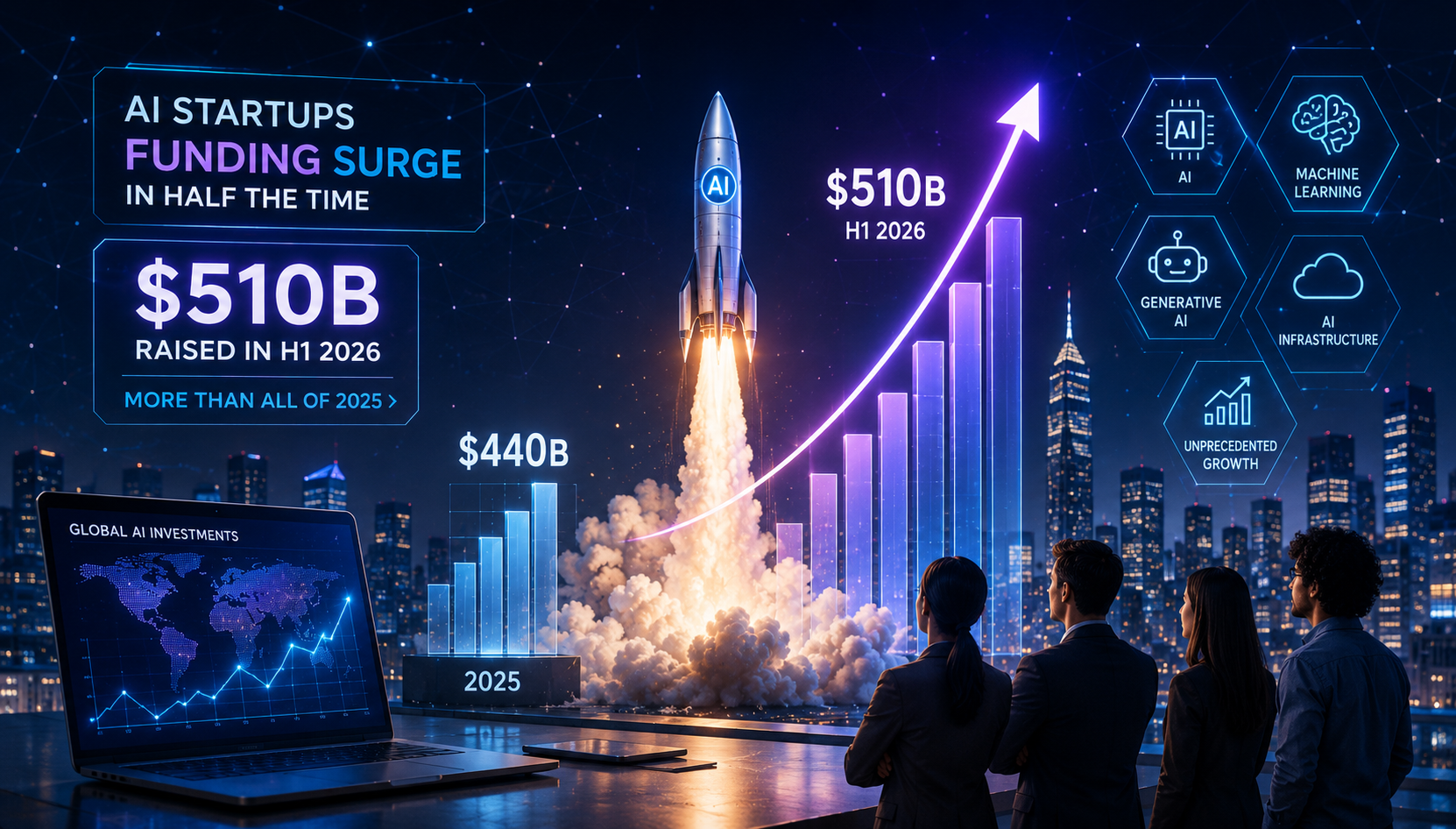
The AI industry didn’t just match last year’s investment total. It beat it by mid-year, with six months to spare.
Global startup investment hit a record $510 billion in the first half of 2026, according to Crunchbase data, already surpassing the $440 billion raised across the entirety of 2025. Nearly 40 AI startups crossed unicorn status (a valuation of $1 billion or more) in that same six-month window, with individual valuations climbing as high as $41 billion.
What stands out isn’t just the size of the number , it’s where the money is going. July alone saw more than $1 billion invested across eight AI startups spanning healthcare, infrastructure, identity verification, voice AI, coding platforms, enterprise automation, and even matchmaking. That spread suggests investors aren’t betting on a single winner-take-all race between a handful of frontier labs , they’re treating AI as a layer running through nearly every industry.
A few individual rounds from July give a sense of scale: AIsphere raised a $439 million Series C led by Alibaba Group, closed July 14. Acrab pulled in a $350 million raise announced July 13. And Lyzr AI closed a $100 million round at a $500 million valuation, also announced July 13. None of these are household names , which is itself part of the story. The capital isn’t only chasing the companies everyone’s already heard of.
Zoom out further, and the money is flowing specifically into infrastructure, semiconductors, robotics, and domain-specific applications, alongside the foundation-model layer itself. Investors appear to be backing the full stack , the chips, the data centers, and the specialized tools built on top of general-purpose models , rather than just the chatbots sitting on top.
That pattern lines up with what’s happening at the very top of the industry, too. Frontier labs are locking in enormous, multi-year compute commitments to match the demand this funding wave is betting on: OpenAI’s infrastructure commitment runs to roughly $750 billion through 2030, while Anthropic has signed a $40 billion multi-year compute deal with xAI. Spending at that scale only makes sense if the demand curve venture investors are betting on keeps compounding at 2026’s pace.
Whether it actually does is the open question sitting under every one of these numbers. For now, both the venture money and the infrastructure money are betting in the same direction , and neither side seems to be hedging.
EntrepreneursLeague is an initiative to support startups and leading entrepreneurs with more visibility, resources, and community for growth and networking.