
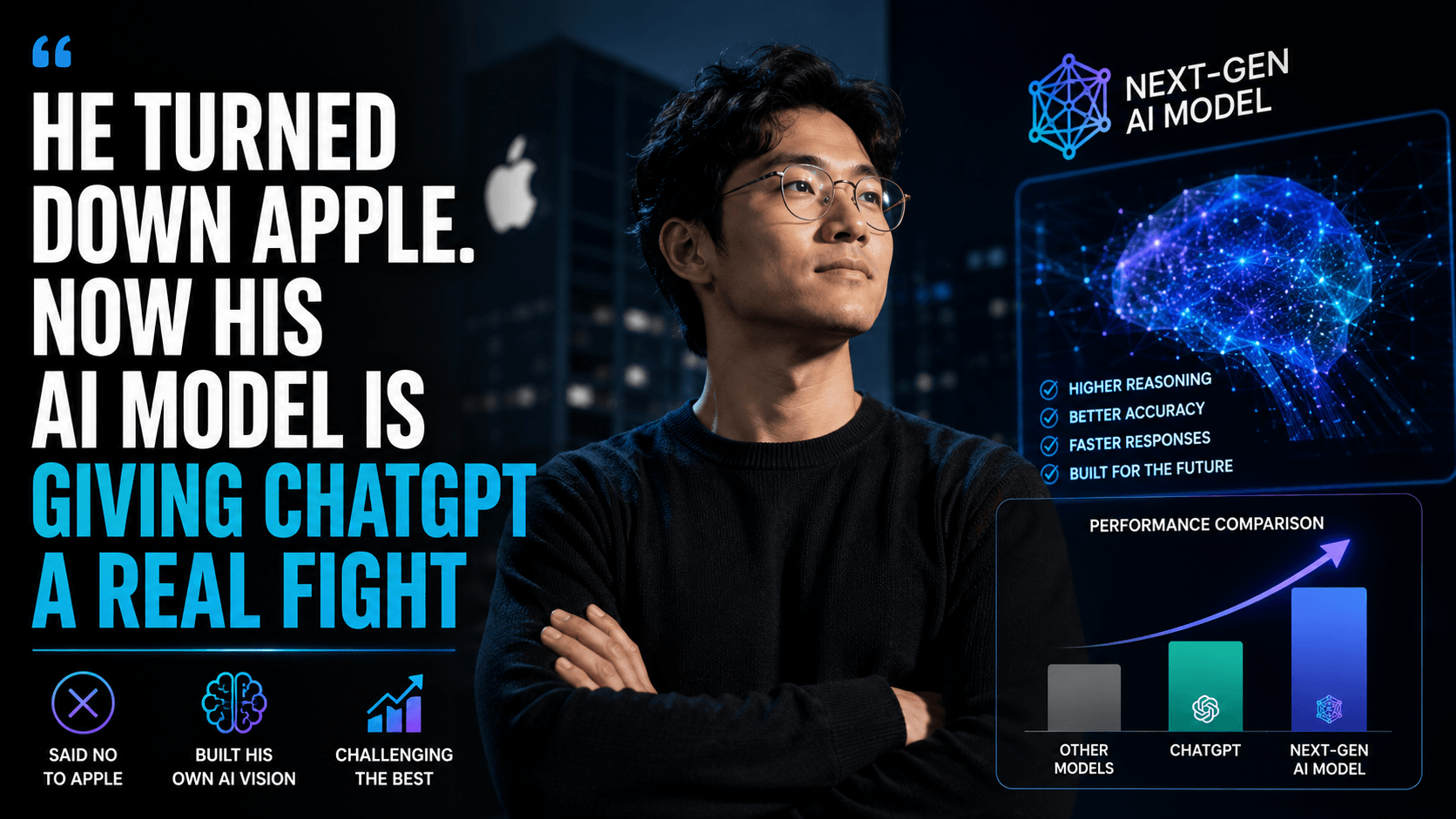
Yang Zhilin had the kind of offer most engineers spend a career chasing, a senior role at Apple reporting into Tim Cook’s inner circle. He turned it down.
Trained at Tsinghua University and later mentored at Carnegie Mellon by a former Apple and Meta AI executive, Yang was, by most measures, exactly the kind of hire Silicon Valley wants to lock down early. According to his former adviser, AI researcher Ruslan Salakhutdinov, Yang’s reasoning was simple: if he never tried building something of his own, he’d regret it for the rest of his life.
Three years later, at 32, Yang is one of China’s youngest AI founders, and the company he built, Moonshot AI, is now rattling an industry dominated by American labs. Its model, Kimi K3, is emerging as one of the sharpest challenges yet to ChatGPT’s position at the top of the market.
The traction has been immediate. Within two days of release, demand for K3 overwhelmed Moonshot’s servers, forcing the company to pause new subscriptions. The model approaches the performance of frontier systems like GPT 5.6 Sol and Claude Fable 5 on major benchmarks, and it does so for free, released openly so developers can download, modify, and self-host it. That combination, frontier-level output, no cost, and full control over the model’s weights, isn’t something OpenAI or Anthropic currently offers. For enterprises wary of handing sensitive data to closed, proprietary providers, K3 represents a genuinely different option, not just a cheaper one.
Yang founded Moonshot AI in 2023 after returning to China, betting that the country’s research talent, government backing, and venture capital ecosystem offered fertile ground for an ambitious AI startup. The company has since raised hundreds of millions of dollars and become one of China’s fastest-growing AI firms.
The rise hasn’t come without friction. US officials, including the White House’s science and technology policy director, along with Anthropic’s policy leadership, have accused Moonshot of distilling its model from Anthropic’s Fable. Moonshot has firmly denied the claim, and independent analysts have raised doubts about the accusation’s timeline, noting that access to rival models was limited before K3’s launch in a way that makes the alleged distillation difficult to square with the facts. US Treasury officials have separately floated the possibility of sanctions against Chinese firms suspected of large-scale IP theft, though no formal action tied to this case has been confirmed.
Whatever the resolution, K3 points to something larger than one product cycle: the gap between Chinese and American frontier AI models has narrowed to a matter of months rather than years. Coming a year after DeepSeek’s own breakout moment, Moonshot’s rise suggests China’s AI breakthroughs may be becoming less an occasional surprise and more a recurring pattern Silicon Valley now has to plan around.

EntrepreneursLeague is an initiative to support startups and leading entrepreneurs with more visibility, resources, and community for growth and networking.